Residential properties in Middle Tennessee face intense stinging insect pressures from late spring through October due to extended humidity cycles documented by the National Weather Service Nashville . Stinging insect…
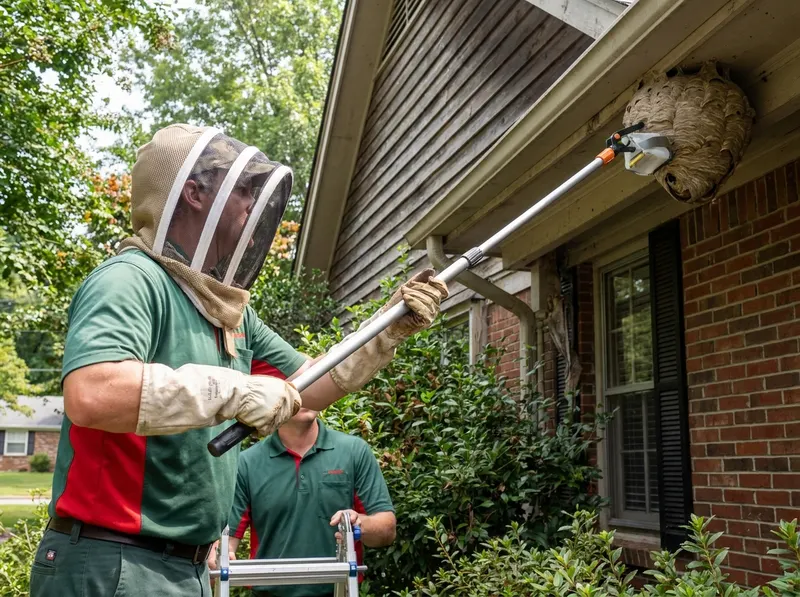
Residential properties in Middle Tennessee face intense stinging insect pressures from late spring through October due to extended humidity cycles documented by the National Weather Service Nashville. Stinging insect nest extraction prioritizes surgical, family-safe physical removal of colonies over broad-spectrum broadcast spraying. Paper wasps (Polistes dominula) frequently construct open comb structures beneath the deep porch eaves of historic bungalows in East Nashville, 12 South, and Belmont-Hillsboro. In contrast, aerial bald-faced hornets (Dolichovespula maculata) and ground-nesting yellowjackets (Vespula squamosa) favor dense canopy foliage near Radnor Lake State Park and Shelby Bottoms Greenway, as well as unsealed soffits on older ranches in Donelson and Inglewood. Left unaddressed, mature autumn yellowjacket colonies can exceed 4,000 workers, escalating stinging risks for children and domestic pets. Ground treatments and exterior cavity extractions align strictly with protective standards outlined by the EPA Safe Pest Control guidelines and pollinator preservation protocols from the Xerces Society.
Cavity-bound extractions demand distinct engineering compared to exterior branch removals. When yellowjackets establish colonies within brick weep screeds, attic dormers, or crawlspace framing, common occurrences in Green Hills and The Nations, over-the-counter aerosol knockdowns routinely fail by driving agitated insects through drywall gaps into living rooms. SilverFern Bug Services conducts targeted void treatments using non-repellent dusts verified under National Pest Management Association technical standards, followed by complete mechanical extraction of the central brood comb to prevent secondary infestations of dermestid beetles. Entry points are permanently blocked with galvanized copper mesh conforming to residential structural exclusion methods published by the Purdue University Extension. Botanical barrier products derived from plant essential oils are applied around window perimeters and patio covers to deter territorial queens from re-scenting prior nest sites, meeting criteria set by the Association of American Pesticide Control Officials.
1. Technicians initiate a 360-degree exterior inspection to isolate entry points, determine species flight vectors, and verify surrounding non-target insect risks.
2. Specialized containment suits conforming to OSHA Personal Protective Equipment specifications are donned before deploying micro-injection applicators directly into the primary nest aperture.
3. The paper comb, brood cells, and surrounding envelope are mechanically severed, vacuum-collected, or scraped into sealed retrieval containers, completely removing dead biomass.
4. Sub-fascia voids and wall cavities undergo directional residual micro-dusting via low-pressure equipment calibrated according to Tennessee Department of Agriculture commercial applicator requirements.
5. Technicians mechanically seal exterior structural seams larger than 1/4 inch using weather-resistant elastomeric sealants or architectural brass screens to prevent autumn re-entry, referencing building tightness recommendations from the International Association of Certified Home Inspectors.
Every job gets a firm, written price after a free on-site visit.
For standards, safe disposal, and service guidance on pest control services in Nashville, TN, useful references include U.S. EPA, ENERGY STAR, U.S. Dept. of Energy, Consumer.gov, U.S. Census Bureau, and Google Maps. General consumer and small-business resources are available from USA.gov, Better Business Bureau, FTC Consumer Advice, U.S. Small Business Administration, and Ready.gov.
Tell us about your stinging insect nest extraction job in Nashville and we'll send a clear, written quote, usually the same day.
 SilverFern Bug Services