Subterranean termite defense in Middle Tennessee requires methods suited to regional clay soils and foundation architecture. Nashville residences, ranging from historic brick piers in Belmont-Hillsboro and Germantown…
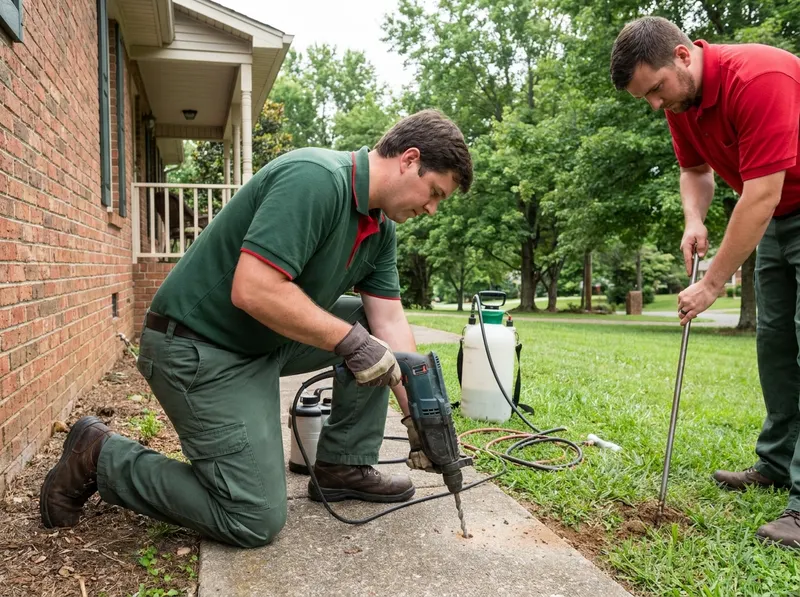
Subterranean termite defense in Middle Tennessee requires methods suited to regional clay soils and foundation architecture. Nashville residences, ranging from historic brick piers in Belmont-Hillsboro and Germantown to block foundations over crawlspaces in Inglewood, Donelson, and East Nashville, face high ground-moisture levels near the Cumberland River basin. Native subterranean termites nest below the frost line and construct earthen shelter tubes over concrete stem walls and subfloor sills to reach structural framing. Property owners monitoring foundation perimeters can reference guidance from the EPA Safe Pest Control program regarding integrated structural protection. Liquid barrier defenses establish a continuous perimeter using non-repellent termiticides such as fipronil, which termites pass through undetected, transferring the active material back to the reproductive queen per standards documented by the Pest Control Technology Technical Library. In contrast, baiting stations installed flush with turf lines deploy chitin synthesis inhibitors that intercept foraging subterranean workers before they access the sill plate, aligning with research from the Entomological Society of America.
Selecting between a continuous non-repellent liquid trench and an exterior station perimeter depends on construction footprint and crawlspace moisture. Homeowners with continuous poured foundations in Green Hills or Sylvan Park benefit from perimeter soil trenching 6 inches wide and 6 inches deep, creating a persistent protective boundary. However, historic stone footings in 12 South and The Nations often present porous masonry joints where drilling mortar lines is necessary to saturate structural voids, following guidelines from the International Association of Certified Home Inspectors. When homes feature damp, dirt crawlspaces prone to spring condensation, high relative humidity accelerates fungal wood decay alongside termite activity, a dynamic tracked by the University of Tennessee Extension. For homes built near high water tables or sensitive waterways, station systems eliminate soil trenching entirely while providing verifiable colony disruption tracked under Tennessee Department of Agriculture Regulatory Services standards.
Subterranean termite applications differ significantly from drywood fumigation or airborne misting procedures. Subterranean termites require continuous contact with ground moisture, traveling through specialized mud tubes that crawl up foundational piers. To stop structural degradation, technicians systematically treat around plumbing penetrations, grade stakes, and foundation cracks using precise mechanical injectors calibrated to soil density standards from the USDA Natural Resources Conservation Service. Rather than flooding living quarters with volatile chemicals, exterior trenching deposits termiticide directly where structural timbers contact the soil, adhering to guidelines established by the National Pesticide Information Center. Routine annual inspections confirm the barrier remains undisturbed by landscaping shifts, mulch installations, or structural settling, protecting timber framing in accordance with building durability practices outlined by the ASTM International Standards and the National Pest Management Association.
Every job gets a firm, written price after a free on-site visit.
For standards, safe disposal, and service guidance on pest control services in Nashville, TN, useful references include U.S. EPA, ENERGY STAR, U.S. Dept. of Energy, Consumer.gov, U.S. Census Bureau, and Google Maps. General consumer and small-business resources are available from USA.gov, Better Business Bureau, FTC Consumer Advice, U.S. Small Business Administration, and Ready.gov.
Tell us about your subterranean termite treatment job in Nashville and we'll send a clear, written quote, usually the same day.
 SilverFern Bug Services