Brown recluse spiders (*Loxosceles reclusa*) establish dense harborage inside historical framing voids, vented crawlspaces, and cellulose attic insulation throughout Middle Tennessee. A standard general liquid spray…
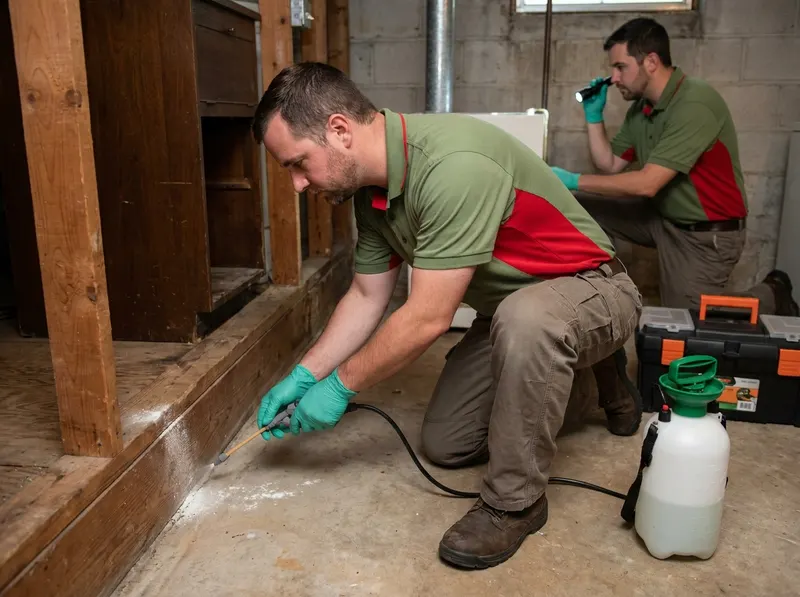
Brown recluse spiders (*Loxosceles reclusa*) establish dense harborage inside historical framing voids, vented crawlspaces, and cellulose attic insulation throughout Middle Tennessee. A standard general liquid spray disperses recluse populations deeper into interior drywall voids rather than eliminating them, because recluses hold their bodies elevated on long tarsi and avoid grooming their legs like cockroaches or ants. Effective structural defense requires physical crack-and-crevice treatments utilizing inert EPA-registered desiccant dusts inside plumbing chases, electrical junction collars, and baseboard junctions. By depositing microscopic silica particles directly into wall voids, technicians abrade the arachnid waxy epicuticle, inducing fatal dehydration without filling family rooms with airborne chemical vapor. Grounded guidance from the University of Kentucky Department of Entomology demonstrates that recluse suppression depends on systematic interception traps alongside physical harborage elimination rather than broadcast space sprays.
Davidson County architectural styles dictate specific mechanical intervention zones. Historical Victorian and craftsman foundations in East Nashville, Germantown, and Belmont-Hillsboro frequently possess unconditioned sandstone or pierced-brick crawlspaces that retain subterranean humidity and provide abundant prey. Technicians access these crawlspaces to seal exterior rim joists, treat sub-floor sub-framing, and seal primary penetration conduits using copper mesh and silicone sealants compliant with OSHA structural entry standards. In mid-century ranches and modern split-levels throughout Donelson, Sylvan Park, and Green Hills, expansive attic footprints beneath asphalt shingles create superheated conditions during summer months. This temperature spike pushes recluses downward into ceiling light fixtures, closet corners, and master bedroom baseboards. Detailed guidance from the University of Tennessee Extension confirms that ambient attic temperatures above 100 degrees Fahrenheit accelerate arachnid dispersion downward into living quarters.
Targeted management differs fundamentally from aggressive, automated quarterly spraying contracts. Rather than locking homeowners into rigid 24-month commitments, SilverFern Bug Services deploys a protective, three-stage clinical remediation model: baseline habitat mapping, precision structural intervention, and targeted exclusionary monitoring. Crawlspace moisture management follows structural recommendations from the HUD Office of Lead Hazard Control and Healthy Homes, minimizing the damp environments that sustain silverfish and booklice, the primary food source sustaining urban recluse colonies. For properties bordered by wooded greenways near the Shelby Bottoms Greenway or the limestone bluffs of Antioch and 12 South, perimeter treatments incorporate exterior mineral bands and targeted applications certified under Tennessee Department of Agriculture pesticide regulations. This ensures dog, cat, and pollinator safety while keeping synthetic residuals strictly outside the living envelope.
Homeowners selecting precision recluse management accept a structured biological timeline: populations drop by 70% to 85% within the first 30 days, while egg-sac cycles require systematic 60-day physical monitoring grids to confirm complete population suppression. The trade-off prioritizes structural exclusion and low-toxicity interior integrity over the short-term optical illusion of instant surface kills. Technicians coordinate monitoring updates in accordance with standards established by the National Pest Management Association and integrated pest strategies documented by the CDC National Center for Environmental Health. Structural adjustments follow building enclosure principles from the Building Science Corporation to maintain home envelope breathability while mechanically barring entry points. Direct service arrangements can be scheduled by calling (615) 537-0360.
Every job gets a firm, written price after a free on-site visit.
For standards, safe disposal, and service guidance on pest control services in Nashville, TN, useful references include U.S. EPA, ENERGY STAR, U.S. Dept. of Energy, Consumer.gov, U.S. Census Bureau, and Google Maps. General consumer and small-business resources are available from USA.gov, Better Business Bureau, FTC Consumer Advice, U.S. Small Business Administration, and Ready.gov.
Tell us about your targeted brown recluse management job in Nashville and we'll send a clear, written quote, usually the same day.
 SilverFern Bug Services